
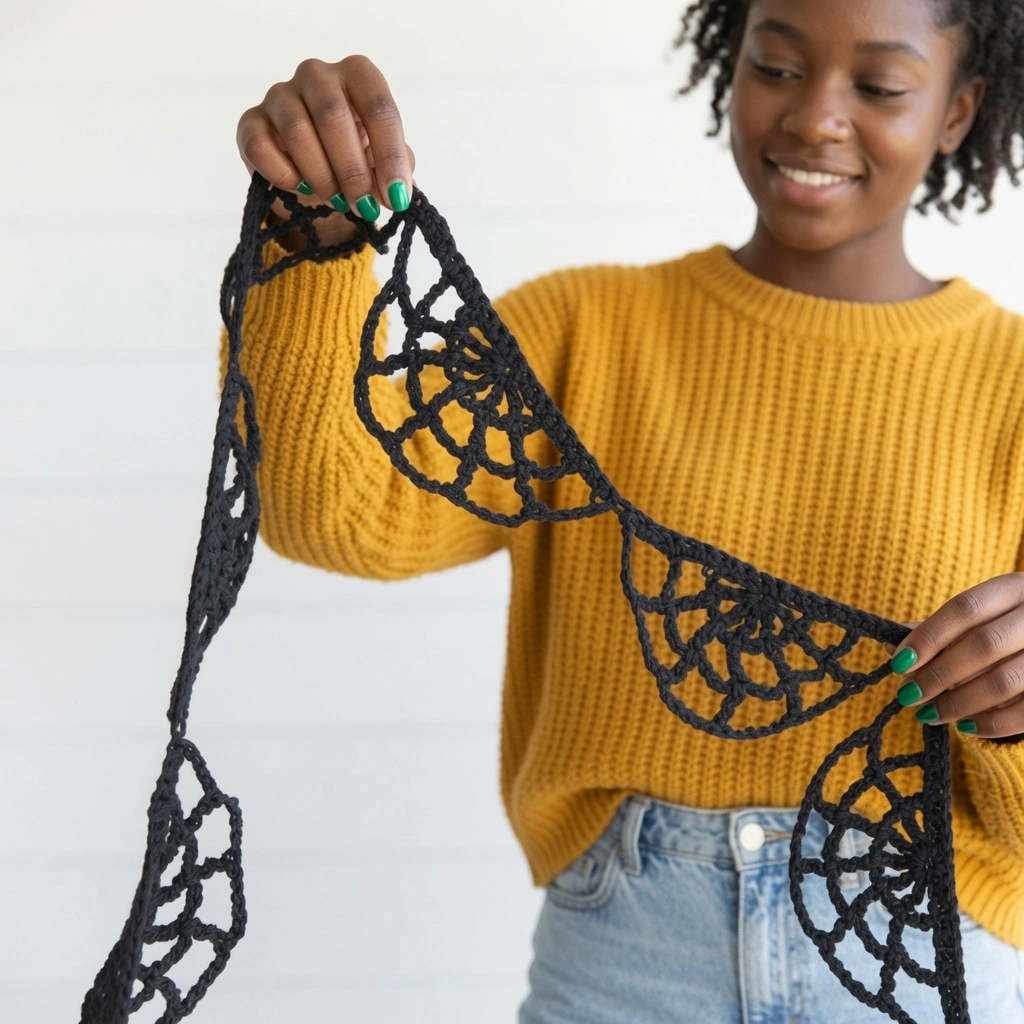
There is nothing quite like the magic of Halloween decorating, and adding handmade touches to your spooky season display brings a special kind of warmth to the chill of autumn. If you are looking for a fast, beginner-friendly project that looks incredibly impressive when hung up, this Easy Crochet Spiderweb Bunting is exactly what you need. It is the perfect way to add a creepy-crawly, vintage vibe to your mantle, staircase, or front porch.
This pattern is wonderfully simple, relying on basic chains and triple crochets to create delicate, arched spiderwebs. Because the webs are joined together as you go, you barely have any ends to weave in, making this a highly rewarding, low-stress project. Even if you have only recently learned how to hold a crochet hook, you can easily complete this bunting in a single afternoon.
Materials Needed
Choosing the right materials is the secret to getting that perfect, stiff spiderweb drape.
- Worsted weight (category 4) cotton yarn
- 4.5 mm crochet hook (equivalent to a US G/7 hook)
- Scissors
Material Notes: I used about 45 grams (roughly 75 yards) of black Loops & Threads Classic Cotton yarn to make a 5.5-foot bunting. Any worsted weight cotton yarn will work beautifully. If you choose to use a blended yarn or another type of fiber, the look and size of the webs will change. You may need to adjust your hook size, and it may not lay as nicely as it does with a thick, stiff cotton yarn.
Because the sizing of this project is highly flexible, feel free to go up or down a hook size if it’s what you have on hand. Just be aware that doing so may slightly change the size of the individual webs and the overall length of your finished bunting.
Gauge & Sizing
Gauge is really difficult to assess with this type of project, and it remains very flexible since this is decorative rather than a wearable garment. Instead of a traditional gauge swatch, I list the exact size of the finished spiderwebs to help you know what to expect and to help you plan for how long you want your bunting to be.
Each spiderweb, after being crocheted into the bunting (which helps stretch and stabilize it), is about 3 inches tall and 6.5 inches wide. I used ten spiderwebs, which created a bunting about 5.5 feet long. Each spiderweb weighed about 3.5g before joining, but a little more yarn and weight is naturally added as they get crocheted together.
Abbreviations Used
- ch = chain
- sc = single crochet
- tc = triple crochet
This pattern uses USA crochet terminology
Pattern Instructions
Spiderwebs
Note: Each web is worked in arched rows.
Starting with a short tail, tie a slip knot.
ROW 1: Ch 5, tc into first ch. Ch 1, tc into first ch. Repeat from * to * five more times. (You should now have 7 tc with 1 ch in between).
ROW 2: Turn, ch 6. Tc into the top of tc from previous row. Ch 3, tc into next tc. Repeat from * to * four more times. Ch 3. Count 3 ch up from the base of the starting chains from the previous row, and tc. (7 tc, with 3 ch in between).
ROW 3: Turn, ch 8. Tc into the top of tc from previous row. Ch 5, tc into next tc. Repeat from * to * four more times. Ch 5. Count 3 ch up from the base of the starting chains from the previous row, and tc. (7 tc, with 5 ch in between).
Cut a 2-3 inch tail and tie off end.
Optional: You can make spiderwebs as large as you want. To increase, add 2 chains to the starting chain and 2 ch to each chain space per row. I prefer the size of 3 rows for a bunting.
Create as many spiderwebs as needed to get the length of bunting you desire. I made a total of 10 to create a 5.5 foot long bunting.
Joining Spiderwebs
Ch 10 (or whatever you prefer to start and end your bunting with). Insert your hook into the last stitch of the 3rd row of one of the spiderwebs (not the starting chain side). Yarn over and pull up a loop. Then complete a sc. Sc into each ch and stitch along the top of the spiderweb. As you sc, place the tails over the top of your spiderweb so that they get enclosed in your stitches and you won’t have to worry about weaving them in later. Be sure you work 3 sc in the last section of the spiderweb, it’s harder to tell how many to work because it’s the side with the starting chains. To add another spiderweb, simply insert your hook into the the end of the 3rd row of another spiderweb. Pull up a loop and continue sc across. (P.S. Notice how working into the top of each spiderweb helps improve its shape and look). After your last spiderweb, end with 10 chains or a mirror of what you worked at the start of the bunting. Tie off your end, and you’re done…almost!
Optional, but recommended: Spray with some starch (the regular starch spray that comes in the laundry aisle) and iron on a high/cotton setting. This helps smooth out and stiffen up your garland.
Optional optional ;)…You can skip the starch, which adds minimal support. Simply ironing it helps block it into shape and is better than not ironing it.
Hang with your Halloween decor and enjoy!

Tips
The magic of this bunting truly happens during the joining and starching process. When you crochet across the top of the webs, you are actively blocking them into a perfect, stretched shape. Catching those 2-3 inch tails under your single crochet stitches is a massive time-saver—embrace it!
When it comes to starching, do not be shy. A floppy spiderweb looks a bit sad, but a heavily starched and ironed web looks like it could have been spun by an actual spider. If you love making holiday decor, this bunting pairs beautifully with other spooky makes, or you can check out the Free Crochet Fairy Pattern for a touch of whimsical autumn magic. For more everyday home accents, our guide on Charming Crochet Decor Patterns is packed with inspiration. If you love buntings but want a different look year-round, try this Crochet Bunting Pattern for a classic granny triangle style.
FAQ
Can I use acrylic yarn instead of cotton? You can, but your results will vary. Cotton yarn has a natural stiffness and weight that helps the spiderwebs hang down perfectly. Acrylic yarn is much lighter and stretchier, meaning your webs might twist or curl rather than laying flat. If you do use acrylic, you will absolutely need to rely heavily on the starching step to give it structure.
What if my webs are curving or twisting? This usually means your tension is too tight, especially on your starting chains. Try to keep your chain stitches loose and relaxed. If you are a tight crocheter, go up a hook size. The stretching action of crocheting the bunting string across the top usually fixes minor twists, but severe curves require a looser tension.
I want a 10-foot bunting. How much yarn do I need? Since 10 webs (5.5 feet) took about 75 yards and 45 grams of yarn, a 10-foot bunting will require roughly 18 to 20 spiderwebs. You will need approximately 140 to 150 yards (around 80-90 grams) of black worsted cotton yarn to complete a bunting of that length.
Conclusion
Congratulations on finishing your spooky spiderweb bunting! This quick, stiffened cotton project is the perfect way to add a touch of handmade magic to your Halloween mantle. Share your finished garland in the comments below!
