
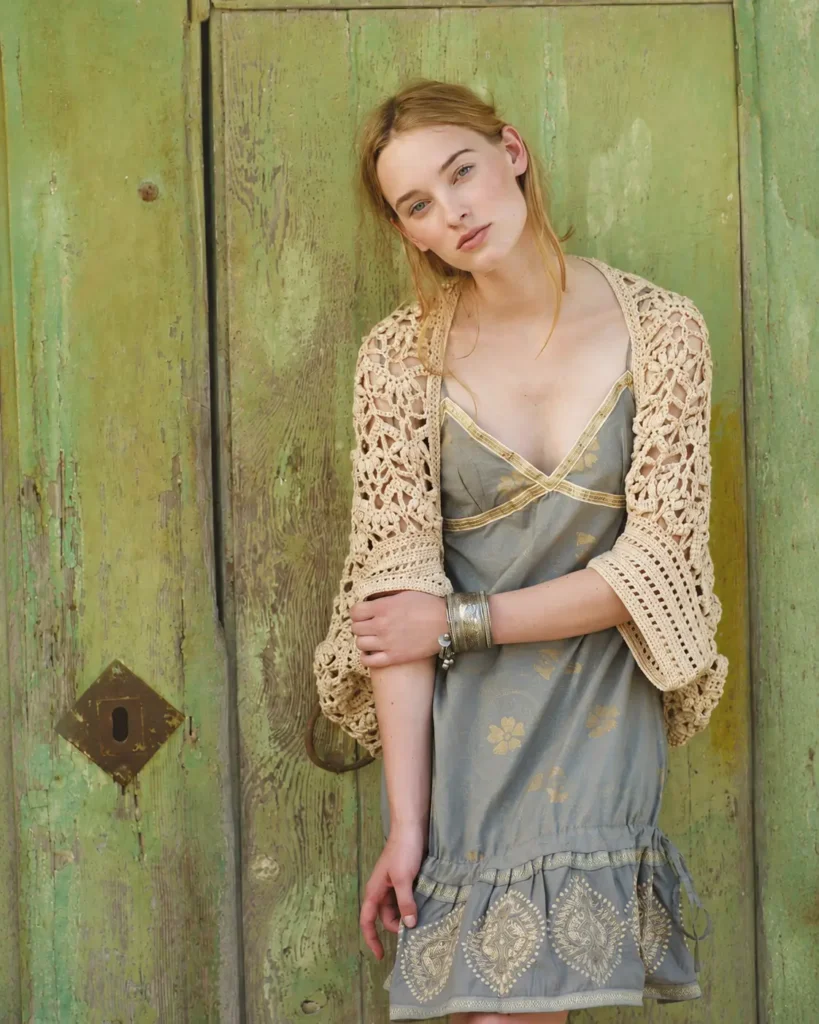
If you’ve been searching for a crochet project that combines bohemian elegance with wearable style, the Mykonos crochet cardigan is exactly what your hook has been waiting for. This open-work lace shrug is designed by Marie Wallin and features an intricate floral crochet pattern that drapes beautifully over the shoulders. Whether you’re heading to a summer festival, a beach holiday, or simply want to elevate your everyday wardrobe, this piece delivers effortless, artisan charm.
In this detailed guide, we’ll walk you through everything you need to know to make this gorgeous crochet cardigan — from materials and sizing to step-by-step construction tips, finishing techniques, and expert advice to fill the gaps beginners often encounter.
What Is the Mykonos Crochet Cardigan?
The Mykonos is a crochet lace cardigan or shrug — a rectangularly constructed garment that wraps around the body to form sleeves and a open back panel. Its name evokes the sun-drenched, whitewashed charm of the Greek island, and the design absolutely delivers on that promise. Think airy, open lacework, delicate floral motifs, and a relaxed fit that pairs effortlessly with summer dresses, camisoles, and flowy blouses.
The construction is brilliantly simple: the garment is worked flat as one large rectangle. The cuffed ends are then seamed to form the sleeves, and the open center drapes as the back and sides. Despite its impressive visual complexity, the structure is beginner-friendly once you understand the stitch pattern.
Sizing and Fit
The Mykonos cardigan comes in two sizes:
- S-M: fits bust 81–97 cm (32–38 in), finished width approximately 86 cm (34 in), length approximately 40 cm (15½ in)
- L-XL: fits bust 102–117 cm (40–46 in), finished width approximately 98 cm (38½ in), length approximately 44 cm (17½ in)
Fit tip for beginners: This pattern is designed with a relaxed, draped silhouette. The finished piece is not meant to be form-fitting — it wraps and drapes naturally. If you’re between sizes, go up rather than down for maximum comfort and wearability.
Materials You’ll Need
Yarn
The pattern calls for Rowan Cotton Glacé, a lightweight 4-ply mercerized cotton yarn. You’ll need:
- 14 x 50g balls for size S-M
- 16 x 50g balls for size L-XL
The sample garment is worked in shade Oyster 730, a soft, warm cream that beautifully showcases the lace pattern. That said, this design works equally well in other neutrals like sand, pale blush, or ivory. For a bolder look, consider dusty rose or sage green.
Yarn substitution tips: If you’d like to substitute Cotton Glacé, look for a 4-ply (fingering weight) cotton or cotton-blend yarn with a slight sheen. Avoid overly textured or matte yarns as they can obscure the delicate lace detail. Check that your substitute has a similar meterage per ball — Cotton Glacé offers approximately 115 m per 50g ball.
Crochet Hooks
You’ll need two crochet hooks for this project:
- 3.00mm (US C2) — used for the cuffed sections worked with a single strand of yarn
- 6.00mm (US J10) — used for the main lace body worked with two strands of yarn held together
The shift between hook sizes creates a lovely contrast: tighter, more structured cuffs frame the open, airy lace body.
Other Supplies
- Scissors
- Yarn needle (tapestry needle) for weaving in ends and seaming
- Stitch markers (optional but helpful for tracking pattern repeats)
- Blocking mat and pins (essential for finishing)
Tension / Gauge
Getting your tension right is crucial for this pattern. The main lace body is worked at:
2 pattern repeats (16 sts) to 14 cm and 3 pattern repeats (12 rows) to 15 cm
Measured over the main pattern using a 6.00mm hook with 2 strands of yarn held together.
Why tension matters here: Because this is a wearable garment (not a decorative piece), incorrect tension will affect the finished size significantly. Always work a gauge swatch before beginning, and if your swatch is too tight, go up a hook size; if too loose, go down.
How to swatch: Chain 20, then work the foundation row and several rows of main pattern. After blocking, measure your swatch and compare to the given tension. Blocking is key for cotton — it opens up the lacework and gives accurate measurements.
Special Abbreviations and Stitch Guide
Before diving in, familiarize yourself with these key stitches used in the pattern:
| Term | Meaning |
|---|---|
| dc | Double crochet (UK) = Single crochet (US) |
| tr | Treble crochet (UK) = Double crochet (US) |
| dtr | Double treble crochet (UK) = Triple crochet (US) |
| ch | Chain |
| ch sp | Chain space |
| ss | Slip stitch |
| yoh | Yarn over hook |
| cluster | (yoh, insert hook, yoh, draw loop through) × 3, yoh and draw through 6 loops, yoh and draw through remaining 2 loops |
| dc2tog | Double crochet 2 together decrease: (insert hook, yoh, draw loop through) × 2, yoh, draw through all 3 loops |
Important note for US crocheters: This pattern uses UK crochet terminology. Always double-check your stitch names — a UK “double crochet” is equivalent to a US “single crochet,” and a UK “treble” equals a US “double crochet.”

Pattern Structure Overview
The Mykonos cardigan is made up of three distinct sections:
- First Cuff — worked flat in a textured cuff pattern using a single strand and the 3mm hook
- Main Lace Body — the show-stopping open lace section worked with two strands held together on the 6mm hook
- Second Cuff — a mirror of the first cuff, returning to single strand and 3mm hook
Then after assembly, an edging is added around the lower and neck opening.
Step-by-Step Construction
Step 1: Foundation Chain and First Cuff
Using your 3.00mm hook and a single strand of yarn, chain 90 [98].
Work the foundation row into the back bump of each chain for a neater edge: 1 dc into 2nd chain from hook, 1 dc into each chain to end. You’ll have 89 [97] sts.
The cuff pattern is a 4-row repeat:
- Rows 1 & 2: Plain dc across (creates a neat fabric base)
- Row 3: A simple mesh of trebles and chain-1 spaces (adds subtle texture and airiness)
- Row 4: Dc worked into the trebles and chain spaces (closes the mesh back into a flat fabric)
Work this 4-row repeat a total of 5 times (18 rows), then work 2 additional plain dc rows. This gives the cuff a lovely elastic quality while maintaining structure.
Tip: Mark each 4-row repeat with a stitch marker or tally mark as you go — it’s easy to lose count.
Step 2: Transition to Main Lace Body
Switch to your 6.00mm hook and join a second strand of yarn. You’ll now be working with both strands held together throughout the main section.
Work the transition row, which sets up the foundation of the lace pattern by creating a series of dc stitches and chain-3 arch formations with trebles. This creates 11 [12] pattern repeats across the row.
Tip for managing two strands: Wind both balls so they feed from the center. Place them in a zip-lock bag or project bag to prevent tangling. Keep even tension on both strands throughout.
Step 3: The 4-Row Main Lace Pattern
The heart of the Mykonos is its 4-row lace repeat, which creates the signature floral open-work motif. Here’s a breakdown of what each row achieves:
Row 1 (Wrong Side): Fills in the foundation arches with groups of dc stitches, building the “petal” shapes of each motif. You’re essentially sculpting the base of each flower.
Row 2: Works dramatic cluster stitches separated by chain-3 spaces, with tall dtr stitches at the boundaries. This is the most complex row but creates the distinctive raised texture of the lace.
Row 3: Works simple dc stitches into the chain spaces between clusters, connected by chain-4 arches. This row “opens up” the motif and creates the airy, flowing look.
Row 4: Re-establishes the arch framework for the next motif repeat, mirroring the transition row from the beginning.
How long to work the main section:
- Size S-M: Work until the body measures approximately 70 cm from the beginning of the main lace pattern
- Size L-XL: Work until the body measures approximately 82 cm from the beginning of the main lace pattern
Always end after completing Row 3 of the pattern, with the right side facing for the next row.
Step 4: Second Cuff
Break off one strand of yarn and switch back to the 3.00mm hook, working with a single strand only.
Work a transition row that converts the open lace structure back into the 89 [97] stitch count needed for the cuff. Then work the 4-row cuff pattern for 18 rows, ending with the wrong side facing. Fasten off.
Assembly Instructions
Seaming the Cuffs
Fold the rectangle so the two cuffed ends are at the sides. With right sides together, seam the row-end edges of each cuff section using mattress stitch or whip stitch to form the two sleeve cuffs. Leave the main lace body open — this forms the back panel and the front lapels of the cardigan.
Seaming tip: Use a yarn needle and a single strand of yarn. Work from the cuff edge inward for approximately 18–20 cm on each side to form sleeves of a comfortable length, then leave the rest open.
Lower and Neck Edging
With the right side facing, using your 3.00mm hook and a single strand of yarn, attach yarn to the top of one cuff seam and work 1 round of dc evenly around the entire open edge (the lower body and neck opening). Make sure your total stitch count is divisible by 5.
Then work the shaping round:
- 1 dc, dc2tog over next 2 dc, 1 dc into each of next 2 dc — repeat to end, slip stitch to join, turn
Follow with 2 more plain rounds of dc, joining each with a slip stitch. Fasten off.
This edging gives a neat, professional finish to the open edges and subtly draws in the silhouette.
Blocking: The Step You Cannot Skip
Cotton yarn responds dramatically to blocking, and the Mykonos pattern absolutely requires it to look its best.
How to block your finished cardigan:
- Soak the finished piece in cool water with a drop of wool wash for 15–20 minutes
- Gently squeeze out excess water — do not wring or twist
- Roll in a clean towel to remove more moisture
- Lay flat on a blocking mat and pin into shape, stretching the lace open to its full dimensions
- Allow to dry completely (12–24 hours)
Blocking will open up all the lace motifs, even out the stitch definition, and give the piece its final polished appearance. Cotton dries relatively quickly but needs to be fully dry before removing pins.
Styling the Mykonos Cardigan
The Mykonos is endlessly versatile. Here are some styling ideas:
- Summer dress layer: Drape over a slip dress or floral midi dress for a boho-chic festival look
- Beach cover-up: Wear over a swimsuit or bikini top as a lightweight beach layer
- Evening layer: Pair with a silk camisole and wide-leg trousers for effortless evening style
- Casual everyday: Layer over a simple tank top and jeans for a relaxed artisan aesthetic
The Oyster colorway (the photographed shade) is incredibly versatile and pairs with virtually any palette. For a more dramatic look, try deep burgundy, forest green, or midnight navy.
Tips for Beginners and Intermediate Crocheters
If you’re new to lace crochet:
- Work up a small swatch of the main lace pattern before starting the full piece
- Use stitch markers to identify each pattern repeat — this makes it much easier to track where you are
- Don’t be discouraged if your first few rows look uneven — lace often looks messy before blocking
For working with double strands:
- Keep both yarn balls in a small bag to prevent tangles
- Always pick up both strands consistently — if one drops, your gauge will shift
- Wind a small amount of the second ball into a separate center-pull ball for easier management
Common mistakes to avoid:
- Skipping the gauge swatch — this is the most common reason garments don’t fit
- Forgetting to switch hook sizes — the contrast between cuff and body depends on this
- Counting pattern repeats incorrectly — the cluster rows in particular need careful counting
- Not blocking — unblocked lace looks nothing like the finished piece
How This Pattern Compares to Other Crochet Garments
If you enjoy working with open-work crochet stitches and want to explore more geometric or modular construction techniques, you might also love working with granny square-based garments. The same airy, textured quality that makes the Mykonos so wearable also appears in pieces like crochet granny square pants — a fun way to take the granny square aesthetic from accessories to full wardrobe pieces. Similarly, if you want to practice open-work crochet in a smaller project before tackling the Mykonos, try crochet granny square shorts, which use the same lightweight construction principles with less yardage commitment.
For those who want to truly master the granny square — the foundational motif behind so much open-work crochet — our classic granny square pattern guide breaks down every element from foundation ring to border. The cluster stitch work in the Mykonos shares a lot of DNA with traditional granny square construction, so building that skill base will make this pattern much more approachable.
Frequently Asked Questions
Can I use a different yarn weight?
Yes, but you’ll need to adjust your hook size and recalculate your gauge. A DK weight cotton worked on a larger hook with a single strand could give a similar effect, but swatch carefully.
Can I make this longer for a full cardigan look?
Absolutely. Simply work more rows of the main lace pattern before transitioning to the second cuff. Add approximately 4–6 extra cm per additional inch of length desired.
What if my lace pattern isn’t lining up?
Check your stitch count at the end of Row 1 of each repeat. If it’s off, the most common culprit is a missed chain space or an extra stitch inserted at the edges. Place stitch markers at each pattern repeat boundary from the start.
Is this pattern suitable for beginners?
It’s rated as a skill level 2 (out of a higher scale), which places it in the confident beginner to intermediate range. If you’re comfortable with dc, tr, chain spaces, and basic counting, you can tackle this. The cluster stitch sounds intimidating but is actually very rhythmic once you practice it a few times.
How do I care for the finished garment?
Cotton Glacé can be hand washed or machine washed on a gentle cool cycle. Lay flat to dry to maintain the shape. Avoid hanging while wet as cotton is heavy when saturated and may stretch.
Final Thoughts
The Mykonos crochet cardigan is one of those projects that looks far more complex than it is. The open-work lace body, the elegant cuffs, the graceful drape — it all comes together from a simple rectangle with two seams. What makes this pattern so rewarding is how the lace motif builds on itself: once you’ve worked the 4-row repeat a handful of times, it becomes almost meditative.
Whether you’re an intermediate crocheter looking for a wearable showpiece or a beginner ready to level up your skills, the Mykonos delivers. With the right yarn, a little patience during the gauge swatch phase, and a proper blocking session, you’ll have a garment that looks like it belongs in a boutique window — because it genuinely does.
Pick up your hook, grab some beautiful cotton yarn, and bring a little Greek island magic into your wardrobe.
Happy crocheting!
